Posted: January 20, 2026
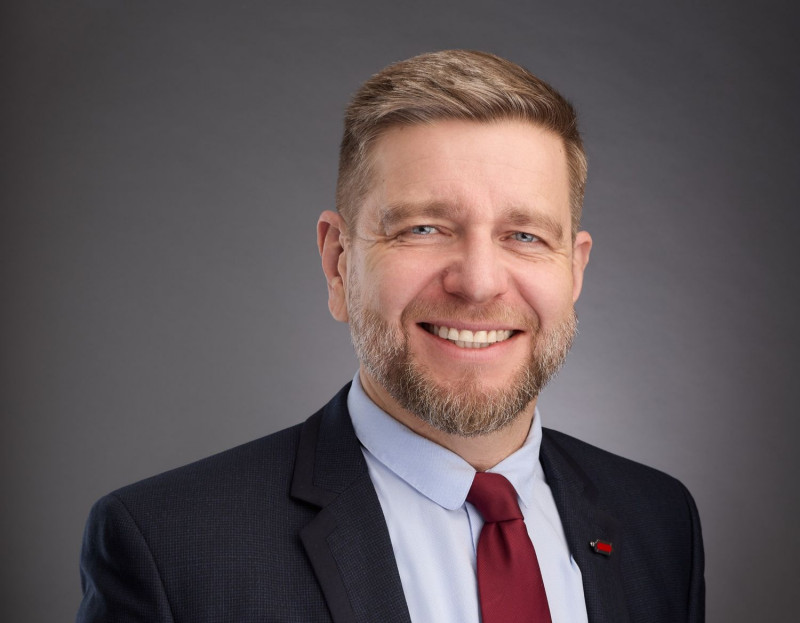
Photo: INSA
The newly started IEA Solar Heating and Cooling Programme Task 75 on Thermal Energy Storage Material aims at taking the successes of previous task work and making them accessible for other research groups. In charge of this communication effort is Professor Frédéric Kuznik from the National Institute for Applied Science (INSA) in Lyon, France. He has already drafted 15 lessons learned on thermal energy storage research in compact phrases, together with justifications that will be discussed by the IEA SHC Task 75 research group. Kuznik started in 2005 as an Associate Professor at INSA and became a full Professor in 2024.
You are part of the management team of the newly started research platform Task 75 on Thermal Energy Storage Materials. What are your research activities at INSA that back up this position?
Kuznik: Since 2008 I have worked in the field of thermochemical storage for buildings and districts. We follow a reverse engineering approach. That means we design, characterize and model storage components for specific applications. Then we define the properties for the material that is best for our application. We then go to the material scientists and ask them for the best-fitting material. Obviously, it rarely happens that they have exactly the right material, but our idea is to try to find the best opportunity.
Why are there so few commercially available compact thermal storage systems using thermochemical material (TCM) despite your nearly 20 years of effort?
Kuznik: You are right. On the phase-change material side it is much easier to commercialize products as the performance of the material only depends on one parameter, the temperature. But for storage with TCMs two parameters are crucial – temperature and humidity, so it is a lot more complicated to control the system and determine the state of charge. Another complex issue is how to integrate the TCMs into the reactor. Most TCMs are available as powder, so you cannot use them directly, you need to encapsulate them and there is a lot of research going on in this field.
We can look back at four tasks about compact thermal energy storage materials within the IEA SHC Programme: Task 67 (2021-2024), Task 58 (2017 to 2019), Task 42 (2009 to 2015) and Task 32 (2003 to 2007). What was achieved?
Kuznik: When we started 20 years ago, there was no standard available to characterize materials for compact thermal energy storage. Each laboratory wrote its own protocols and the data in the literature was not comparable. However, to assess and model the performance of a material you need harmonized test protocols. Therefore, our biggest success was defining a protocol for characterization of phase-change materials and setting up a database of these materials. The work on harmonizing the test procedures for TCMs is still ongoing in the current task.
Now, for the first time, you have created two parallel tasks, Task 75 for materials and Task 74 for components, why is that?
Kuznik: Starting two tasks in parallel was really a good move. In the past, researchers developed storage tank materials without a clear definition of an application. Now, we would like to close the gap between component engineering and material development. All task meetings will be held jointly. The component engineers like my group will sit together with the material researchers to discuss the way we can design TES systems for applications.
One of the main goals of the newly started Task 75 is the dissemination of lessons learned from previous tasks. How did this idea come about?
Kuznik: We have developed test standards, but they are not used everywhere. Within the task we are a small group of, let’s say, 15 institutions, which is a rather small group compared to the global community researching compact thermal energy storage. Therefore, we have to communicate our standard protocol and explain to other laboratories why it is interesting for them to use it. We have decided to define compact lessons learned in one phrase to make them easy to access for other research groups.
Can you give examples of such lessons learned?
Kuznik: One fundamental lesson learned is the following, which also led to us starting two parallel tasks:
Collaboration between material and application experts leads to an improved understanding of material and component design strategies and supports the development of CTES systems.
But as I said, we also have to convince our colleagues from other laboratories, who might not even know about the task work, to accept the need for harmonized test protocols - not only on the material side, but also on the component side. To compare the performance of different components and reactors, we need to agree on operating conditions for the tests. Hence, another important lesson learned is this one:
Standards to measure material properties and to evaluate components are a prerequisite for constructive discussions among experts and for advancing CTES technologies.
Another lesson learned relates to the state of charge. As for electrochemical batteries, where it is easy to find out the state of charge at any time, we need to evaluate the state of charge for thermal batteries. We have made a big effort to develop measures for state of charge determination for thermal batteries in the previous tasks. We have put this effort into the following phrase:
In flexible heating and cooling systems, thermal batteries are needed: TES systems with instantaneous State of Charge (SoC) determination.
What are the next steps regarding the lessons learned?
Kuznik: So far, I have drafted 15 phrases, each of which illustrates a lesson learned and we started the discussion during the last task meeting. Each phrase comes along with a justification of half a page. We obviously need time to discuss these justifications because we have to speak the same language. Our objective is to publish overview papers about the lessons learned – one for PCMs and one for TCMs.
Websites of organizations mentioned in this interview: